Horizon Despike: Despiking Parameters
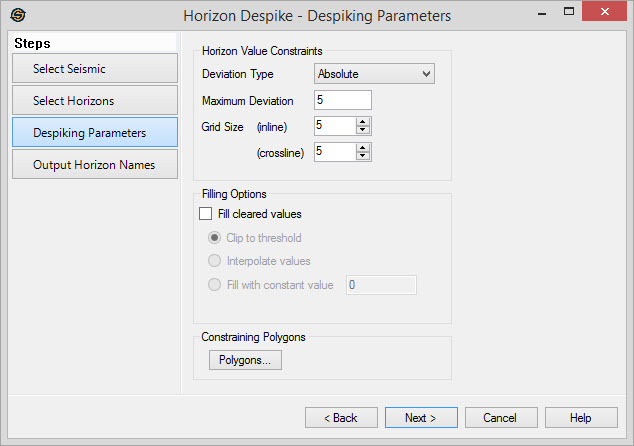
Horizon Value Constraints
Select the criteria for identifying spikes in the horizon data.
Values that deviate beyond a threshold from the local mean are
identified as "spikes".
Deviation Type: Select the method for identifying spikes.
- Absolute: Identifies and clears points that are an absolute value away from the mean (calculated from the grid). The absolute value is determined by the Maximum Deviation value that you enter and measured in the units of the horizon (structure/amplitude).
- Percent: Identifies and clears points that are a given percentage value away from the mean (calculated from the grid). The percentage absolute value is determined by the Maximum Deviation value that you enter.
- Standard Deviation: Identifies and clears points that are not within the specified number of standard deviations from the mean (calculated from the grid). The number of standard deviations is determined by the Maximum Deviation value that you enter.
Maximum Deviation:The magnitude by which a value can deviate from the mean, in units specified under Deviation Type.
Grid Size (inline/crossline):Dimensions of the bin defining the local area of a horizon data point.
Filling Options
Options for filling cleared spikes. By default, spikes are cleared and
horizons left blank.
Fill Cleared values: Turn on this option to fill clear values instead of leaving horizons blank, and then select the fill method.
Clip to threshold:Sets the value of a spike data point to that of the threshold it exceeded.
Interpolate values: Sets the value of a spike data point to that of the local mean.
Fill with constant value:
Sets the value of a spike data point to a given value.
Constraining Polygons:
 Polygons: Click to open theSelect Polygons dialog to use
a polygon to limit the geographical extents of your despiking operation.
Polygons: Click to open theSelect Polygons dialog to use
a polygon to limit the geographical extents of your despiking operation.
— MORE INFORMATION

|
Copyright © 2020 | SeisWare International Inc. | All rights reserved |